
China Sourcing Explained: From Product Request to Final Delivery
China Sourcing Explained: From Product Request to Final Delivery
Sourcing products from China can look simple from the outside.
Find a supplier, ask for a price, place an order, and wait for the goods to arrive.
In reality, a professional sourcing process includes many more stages.
The buyer needs to define the product correctly, identify suitable suppliers, compare quotations, confirm specifications, evaluate samples, negotiate terms, follow production, inspect the goods, coordinate shipping, and manage documentation.
Each stage affects the final cost, quality, delivery time, and overall risk of the order.
This guide explains the complete China sourcing process from the initial product request to final delivery.
What Is China Sourcing?
China sourcing is the process of identifying, evaluating, purchasing, and coordinating products or manufacturing services from suppliers in China.
Depending on the project, sourcing may include:
- Supplier research
- Manufacturer identification
- Quotation collection
- Supplier comparison
- Supplier verification
- Product sampling
- MOQ negotiation
- Price negotiation
- Procurement coordination
- Production follow-up
- Quality control
- Packaging coordination
- Freight planning
- Shipping
- Delivery coordination
For simple products, the process may be relatively short.
For custom products, industrial components, private-label goods, or large orders, the sourcing process can become much more detailed.
Step 1: Submit a Clear Product Request
Every sourcing project begins with the buyer’s requirements.
The more accurate the initial request is, the more efficient the sourcing process becomes.
A good sourcing request should include:
- Product name
- Product category
- Required specifications
- Material
- Dimensions
- Estimated quantity
- Preferred quality level
- Packaging requirements
- Branding requirements
- Target market
- Delivery destination
- Reference images
- Product links
- Technical drawings
- Certifications, if required
If the product is already available in another market, a reference link can help suppliers understand the requirement more quickly.
For custom-manufactured products, drawings and specifications become especially important.
Why Product Details Matter
Suppliers cannot provide accurate quotations without accurate requirements.
If two suppliers quote different specifications, comparing their prices becomes meaningless.
For example, two factories may both quote a power bank, but one may use:
- Different battery cells
- Different capacity
- Different safety components
- Different packaging
- Different certifications
The cheapest quotation may simply represent a different product.
Step 2: Research Potential Suppliers
Once the requirement is clear, supplier research begins.
Potential suppliers may be identified through several channels:
- B2B marketplaces
- Trade fairs
- Industry directories
- Domestic Chinese platforms
- Existing supplier networks
- Factory referrals
- Sourcing companies
- Direct manufacturer research
The objective is not to find one supplier immediately.
The objective is to build a qualified shortlist.
Step 3: Create a Supplier Shortlist
A shortlist allows buyers to compare different suppliers before making a decision.
Important factors include:
- Product specialization
- Production capability
- MOQ
- Price
- Lead time
- Customization ability
- Export experience
- Certifications
- Communication quality
- Sample availability
A sourcing project should ideally compare several suppliers before final selection.
This helps the buyer understand the real market range for price, MOQ, and production terms.
Step 4: Verify the Supplier
Before placing a meaningful order, the supplier should be checked.
Supplier verification may involve reviewing:
- Business registration
- Company name
- Factory address
- Business scope
- Manufacturing capability
- Production facilities
- Export experience
- Certifications
- Bank account information
- Product specialization
The goal is to confirm that the supplier is capable of delivering what has been promised.
A legitimate company is not automatically the right supplier.
The company must also have the appropriate capability, experience, and quality systems for the specific product.
Step 5: Request and Compare Quotations
Once suitable suppliers have been identified, quotations are collected.
A quotation should contain more than a unit price.
Important details include:
- Unit price
- MOQ
- Sample cost
- Tooling cost
- Packaging cost
- Branding cost
- Production lead time
- Payment terms
- Incoterm
- Product specifications
- Warranty, where applicable
- Shipping responsibility
Compare Like With Like
Before comparing prices, make sure every supplier is quoting the same product specification.
Otherwise, a lower price may simply mean:
- Lower material quality
- Different packaging
- Fewer accessories
- Lower-grade components
- Different production standards
Price should always be compared together with specifications and terms.
Step 6: Negotiate MOQ, Price, and Terms
Once quotations are available, negotiation begins.
Negotiation can involve:
- Unit price
- MOQ
- Packaging
- Branding
- Payment schedule
- Tooling fees
- Sample cost
- Production lead time
- Inspection arrangements
The lowest possible price is not always the best objective.
A better negotiation aims to create a workable balance between:
Price + Quality + Quantity + Delivery + Risk
Sometimes paying slightly more for a more reliable supplier can reduce problems later.
Step 7: Order Samples
Before mass production, samples are often required.
Samples allow the buyer to confirm:
- Product appearance
- Material
- Dimensions
- Function
- Packaging
- Color
- Printing
- Branding
- Accessories
- Performance
For custom products, several sample revisions may be required.
The final approved sample should be clearly identified and documented.
This sample becomes an important reference for mass production.
Step 8: Confirm the Purchase Order
Once the supplier, specifications, sample, and commercial terms are approved, the order can be confirmed.
The purchase documentation should clearly define:
- Product specification
- Quantity
- Unit price
- Total price
- Packaging
- Branding
- Production time
- Payment terms
- Inspection conditions
- Shipping terms
- Delivery responsibilities
Verbal agreements are not enough for important orders.
Important specifications should be documented in writing.
Step 9: Make the Initial Payment
Many suppliers require a deposit before production begins.
The exact payment structure depends on:
- Product type
- Supplier
- Order value
- Relationship history
- Production requirements
- Customization
Before payment, verify:
- Beneficiary name
- Bank details
- Supplier company details
- Invoice information
- Purchase order information
Any unexpected change in payment information should be independently verified.
Step 10: Production Begins
Once the deposit is received, production begins.
The production process may include:
- Material purchasing
- Component preparation
- Manufacturing
- Assembly
- Printing
- Branding
- Packaging
- Testing
For longer or more complex orders, production follow-up becomes important.
Regular updates help identify delays before they become serious problems.
Step 11: Production Follow-Up
Professional sourcing does not stop after payment.
Production should be monitored.
Follow-up may include:
- Production schedule
- Material availability
- Manufacturing progress
- Packaging preparation
- Branding progress
- Expected completion date
- Potential delays
Production follow-up is especially important for seasonal products or orders with strict delivery deadlines.
Step 12: Quality Control and Inspection
Before goods leave the supplier, quality should be checked.
Depending on the product and order size, inspection may occur at different stages.
Pre-Production Inspection
Materials and components are checked before production.
During Production Inspection
Goods are inspected while manufacturing is still in progress.
Pre-Shipment Inspection
Finished products are checked before shipment.
This stage may include:
- Quantity verification
- Visual inspection
- Functional testing
- Dimension checks
- Packaging checks
- Label verification
- Accessory checks
Problems are much easier to solve before the goods leave the factory.
Step 13: Final Payment
Depending on the agreed payment terms, the remaining balance may become due after production or inspection.
Before final payment, the buyer should confirm:
- Production completion
- Inspection result
- Final quantity
- Packaging status
- Shipping readiness
For higher-risk orders, inspection before final payment can provide an additional layer of control.
Step 14: Choose the Shipping Method
The best shipping method depends on the order.
Common options include:
- Air freight
- Sea freight
- Land freight
- Courier or express shipping
- Combined transport
The right method depends on:
- Product size
- Weight
- Order value
- Urgency
- Destination
- Budget
Air Freight
Usually faster, but more expensive.
Often suitable for:
- Smaller shipments
- High-value goods
- Time-sensitive orders
Sea Freight
Usually more economical for larger shipments.
Often suitable for:
- Bulk cargo
- Heavy goods
- Larger commercial orders
There is no single best shipping method.
The correct choice depends on the specific shipment.
Step 15: Prepare Shipping Documents
International shipping may require several documents.
Depending on the shipment, these may include:
- Commercial invoice
- Packing list
- Bill of lading
- Air waybill
- Certificate of origin
- Product certificates
- Customs documents
Documentation requirements vary depending on:
- Product type
- Destination country
- Shipping method
- Customs regulations
Incorrect documentation can cause delays or additional costs.
Step 16: International Shipping
Once the goods are ready and documentation is complete, the shipment leaves China.
During this stage, the buyer or sourcing team may track:
- Departure
- Transit
- Port or airport status
- Estimated arrival
- Customs processing
International shipping times can vary.
Weather, port congestion, customs procedures, and logistics conditions can affect delivery.
Step 17: Customs Clearance
When the shipment reaches the destination country, it may require customs clearance.
Depending on local regulations, this can involve:
- Import documentation
- Customs declarations
- Duties
- Taxes
- Product approvals
- Inspection
Import requirements should ideally be checked before placing the order.
Otherwise, a product may arrive at the destination and encounter unexpected regulatory problems.
Step 18: Final Delivery
After customs clearance, the goods can be delivered to:
- Warehouse
- Retail business
- Distributor
- Factory
- Office
- Final customer
At this point, the sourcing cycle is complete.
But the supplier relationship may continue.
Step 19: Review Supplier Performance
After delivery, evaluate the supplier.
Important questions include:
- Was the product quality acceptable?
- Was production completed on time?
- Was communication clear?
- Was packaging suitable?
- Were specifications followed?
- Were problems handled professionally?
- Was the final cost acceptable?
This information helps determine whether the supplier should be used again.
The Complete China Sourcing Process
The process can be summarized as:
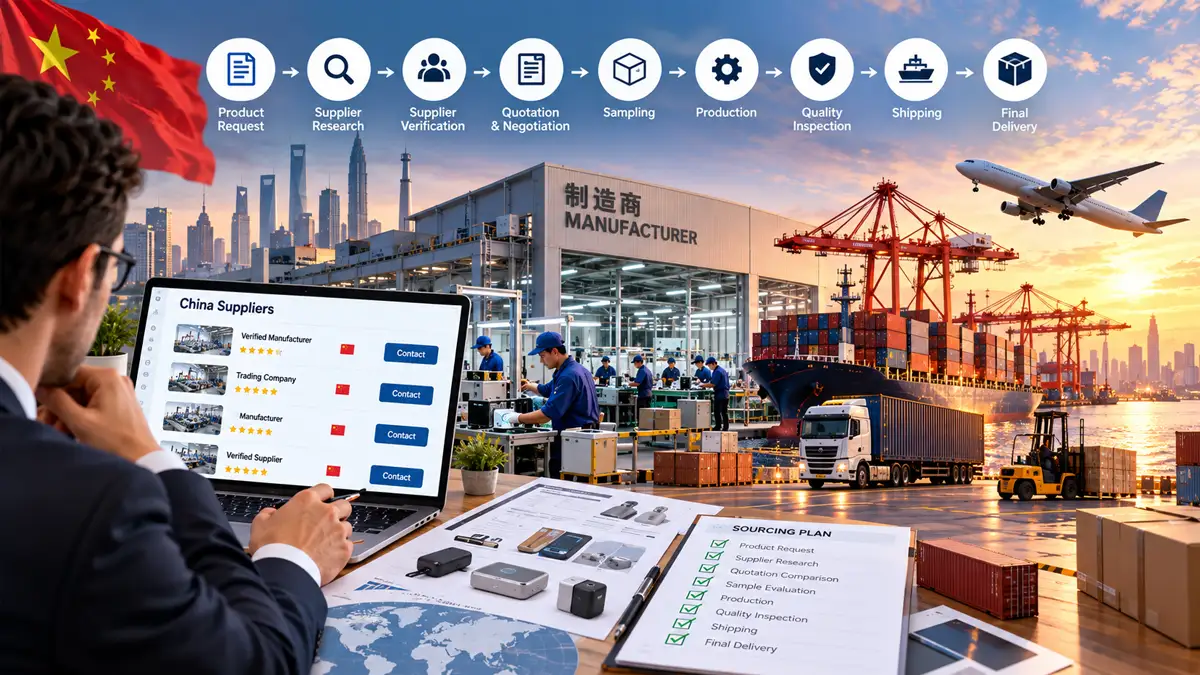
Product Request → Supplier Research → Supplier Verification → Quotation → Negotiation → Sampling → Order Confirmation → Production → Quality Control → Shipping → Customs → Delivery
Each stage reduces uncertainty and helps the buyer make better decisions.
Skipping stages may save time initially, but it can create larger problems later.
Common China Sourcing Mistakes
Buyers often encounter problems because they move too quickly.
Common mistakes include:
- Choosing the first supplier found
- Selecting only based on price
- Not verifying the company
- Skipping samples
- Using unclear specifications
- Paying before confirming details
- Not inspecting the goods
- Ignoring packaging requirements
- Choosing shipping too late
- Not checking import requirements
A structured sourcing process helps reduce these risks.
What Does a China Sourcing Company Do?
A sourcing company may support different parts of the process.
Services can include:
- Supplier research
- Supplier comparison
- Supplier verification
- Negotiation
- Sample coordination
- Procurement
- Production follow-up
- Quality-control coordination
- Shipping coordination
The exact service depends on the project.
The main purpose is to make the sourcing process easier to manage, especially for buyers who do not have their own team in China.
How SabaDigi Supports the Sourcing Process
SabaDigi helps businesses coordinate sourcing and procurement from China.
Depending on the project, support may include:
- Product research
- Supplier sourcing
- Supplier comparison
- Supplier communication
- Quotation collection
- Negotiation support
- Sample coordination
- Procurement coordination
- Production follow-up
- Product verification
- Quality-control coordination
- Shipping support
The objective is to help buyers manage the sourcing process more clearly from initial request to delivery.
Start Your Sourcing Request
If you are looking for a product, supplier, factory, or custom manufacturing option in China, provide:
- Product name
- Product specifications
- Estimated quantity
- Images
- Product links
- Technical files
- Destination country
The more information you provide, the easier it becomes to evaluate sourcing options.
CTA:Start a Sourcing Request
Frequently Asked Questions
How does China sourcing work?
China sourcing usually starts with a product requirement, followed by supplier research, quotation comparison, supplier verification, samples, negotiation, production, quality control, shipping, and delivery.
How long does sourcing from China take?
There is no fixed timeline. The process depends on the product, supplier availability, sampling, customization, production time, inspection, and shipping method.
Do I need to visit China to source products?
Not necessarily. Many sourcing projects can be managed remotely through supplier communication, local sourcing teams, factory inspections, and third-party quality-control services.
Should I inspect products before shipping?
For many commercial orders, pre-shipment inspection is recommended because it allows quality issues to be identified before goods leave the supplier.
Can I source small quantities from China?
Yes, but MOQ varies by supplier and product. Some suppliers accept small trial orders, while others require higher minimum quantities.
What information should I send for a sourcing request?
Send the product name, specifications, estimated quantity, images, links, drawings, or technical files whenever possible.
Is sourcing from China only suitable for large companies?
No. Small businesses, distributors, retailers, e-commerce sellers, and corporate buyers can all source from China depending on product and order requirements.
Can SabaDigi manage the complete sourcing process?
SabaDigi can support different stages of sourcing depending on the project, from supplier research and quotation comparison to procurement coordination, product verification, and shipping support.