


How to Find Reliable Suppliers in China
Finding suppliers in China is relatively easy. Finding a supplier that is reliable, suitable for your product, capable of meeting your quality requirements, and able to deliver consistently is much more difficult.
A good sourcing process should not begin with the question,“Who offers the lowest price?”It should begin with a clear product specification and continue with supplier research, verification, quotation comparison, sampling, negotiation, and quality checks.
Whether you are sourcing consumer electronics, automotive parts, petrochemical products, watches, private-label goods, or custom-manufactured products, the same principle applies:treat every supplier as a candidate until their identity and capabilities have been checked.
This guide explains how to find reliable suppliers in China step by step and what you should verify before placing your first order.
1. Define Exactly What You Want to Source
The first mistake many buyers make happens before they contact a single supplier.
They start searching with an unclear requirement such as:
“I need headphones.”
That is not enough information for a manufacturer to provide an accurate quotation.
A useful sourcing request should include as much relevant information as possible, including:
- Product type
- Materials
- Dimensions
- Technical specifications
- Required quantity
- Packaging requirements
- Target quality level
- Branding or private-label requirements
- Certifications, if required
- Target delivery market
- Preferred delivery schedule
If the product already exists, images, product links, drawings, technical files, or reference samples can make the process significantly more accurate.
For custom-manufactured products, specifications become even more important because two factories may interpret the same general request very differently.
Why Specifications Matter
Without clear specifications, you cannot compare supplier quotations properly.
One supplier may quote a lower price because it is offering a different material, thinner packaging, lower-grade components, or different specifications.
The quotation looks cheaper, but the product is not actually comparable.
A clear specification allows every potential supplier to quote against the same requirement.
2. Choose the Right Supplier Search Channels

Comparing Chinese suppliers before placing an order
There is no single place where every good Chinese supplier can be found.
Professional buyers often use several sourcing channels together.
B2B Platforms
Online B2B marketplaces are usually the easiest starting point.
They can help you:
- Discover potential suppliers
- Compare product ranges
- Estimate market pricing
- Understand common MOQ levels
- Identify manufacturing regions
However, an attractive online profile should never be treated as proof that a company is the right supplier.
A supplier may be a manufacturer, trading company, wholesaler, distributor, or intermediary.
The listing is the beginning of the investigation, not the end.
Trade Shows
Trade fairs can be particularly valuable when you need to meet multiple suppliers in the same industry.
They allow buyers to:
- Meet representatives directly
- Examine samples
- Compare products quickly
- Discuss customization
- Establish initial business relationships
Events such as the Canton Fair can provide access to a wide range of manufacturers and exporters.
However, meeting a supplier at a trade show does not remove the need for verification.
Chinese Domestic Platforms
Domestic Chinese sourcing platforms may provide access to suppliers that are less focused on international marketing.
These platforms can sometimes offer wider supplier coverage or more competitive domestic pricing, but they can also create additional challenges related to language, payment, domestic shipping, and communication.
For international buyers, local sourcing support may make these channels easier to use.
Sourcing Companies
A sourcing company can search across multiple channels instead of relying on one marketplace.
The main value is not simply finding a supplier listing.
The useful part is filtering candidates, communicating requirements, comparing quotations, checking suppliers, coordinating samples, and managing the sourcing process on behalf of the buyer.
3. Build a Supplier Shortlist
Do not contact one supplier and immediately start negotiating an order.
Create a shortlist.
For most sourcing projects, comparing several qualified suppliers gives you a much clearer view of:
- Market pricing
- MOQ differences
- Production capabilities
- Lead times
- Customization options
- Communication quality
- Payment requirements
Create a simple supplier comparison sheet.
For each candidate, record:
| Item | What to Check |
|---|---|
| Company name | Full legal business name |
| Location | Province and manufacturing region |
| Supplier type | Manufacturer, trading company, distributor |
| Main products | Relevance to your requirement |
| MOQ | Minimum order quantity |
| Unit price | Based on identical specifications |
| Sample availability | Cost and lead time |
| Production time | Estimated manufacturing lead time |
| Payment terms | Deposit and balance terms |
| Certifications | Where relevant to the product |
| Export experience | Markets previously served |
| Communication | Speed, accuracy and clarity |
This prevents sourcing decisions from being based on memory, impression, or whichever salesperson responds most enthusiastically.
4. Verify the Supplier’s Legal Identity

Chinese supplier factory verification and inspection
Before sending a significant payment, confirm that the company actually exists as presented.
China maintains an official enterprise information system that can be used to search registered businesses and review information such as company registration and business status.bt.gsxt.gov.cn
At minimum, ask the supplier for its business license and compare the information with other documents provided.
Important details may include:
- Registered company name
- Unified Social Credit Code
- Registered address
- Legal representative
- Registration status
- Business scope
- Establishment date
The company name on the quotation, contract, business license, invoice, and receiving bank account should also be reviewed carefully.
Unexpected differences deserve an explanation before payment.
5. Determine Whether You Are Dealing With a Factory or Trading Company
A trading company is not automatically a bad supplier.
In some cases, a trading company may actually be useful because it can consolidate products from several factories or provide better export support.
The important point is knowingwho you are dealing with.
If a supplier claims to be the manufacturer, verify that claim.
Useful questions include:
- Where is the factory located?
- What products are manufactured there?
- What production equipment is available?
- How many production lines are operating?
- Can the factory provide production photos or videos?
- Can a third-party inspection or factory visit be arranged?
- Which production stages are handled internally?
- Which processes are outsourced?
Supplier verification services commonly distinguish between confirming that a company legally exists and verifying whether it actually has the facilities and capability to manufacture the product.Get China Sourcing
That distinction matters.
A legitimate company can still be the wrong supplier for your order.
6. Compare Quotations Properly
The lowest quotation is rarely enough information to make a sourcing decision.
Before comparing prices, make sure every supplier is quoting the same thing.
Check:
- Product specification
- Material
- Included accessories
- Packaging
- Printing or branding
- MOQ
- Sample costs
- Tooling or mold fees
- Production lead time
- Inspection requirements
- Export packaging
- Incoterm
- Shipping responsibilities
A price difference may have a perfectly reasonable explanation.
For example, Supplier A may quote a lower unit price but exclude customized packaging, while Supplier B includes packaging, inspection preparation, and export cartons.
Without comparing the complete quotation, you may choose a lower price that ultimately costs more.
7. Evaluate Communication Quality
Communication is one of the most underestimated parts of supplier selection.
A supplier does not need perfect English.
It does need to understand your requirements and respond accurately.
Watch how the supplier handles questions.
Good signs include:
- Answers specific questions directly
- Confirms specifications in writing
- Identifies unclear requirements
- Provides realistic production timelines
- Explains limitations instead of agreeing to everything
- Keeps quotation details consistent
Warning signs include:
- Constantly changing prices without explanation
- Avoiding technical questions
- Sending generic answers
- Pressuring you to pay immediately
- Refusing reasonable verification requests
- Changing bank information unexpectedly
- Promising unrealistic production times
Sometimes the easiest supplier to communicate with is not the cheapest one, but it may still produce the lower-risk order.
8. Order Samples Before Mass Production
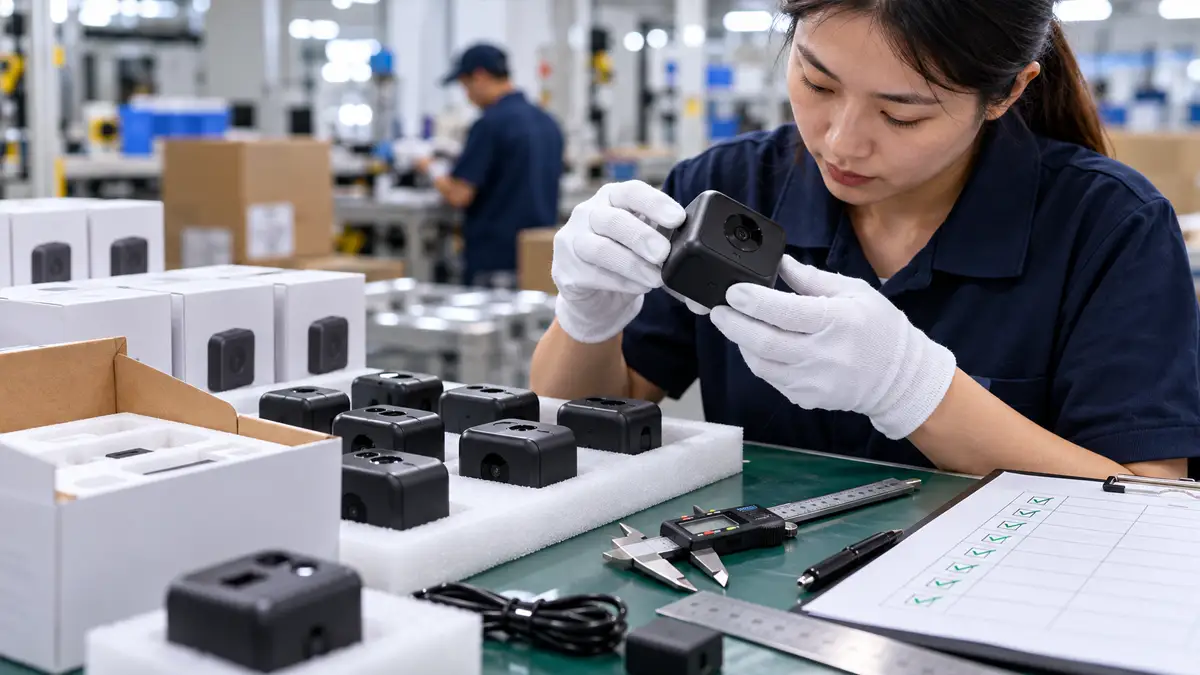
Product sample inspection before mass production in China
A sample allows you to evaluate the product before committing to a larger order.
Depending on the product, evaluate:
- Materials
- Dimensions
- Color
- Finish
- Functionality
- Packaging
- Printing
- Branding
- Accessories
- Performance
- Overall workmanship
Do not rely only on photographs.
If quality matters, request a physical sample.
For custom products, the approved sample should become part of the reference standard for production.
Keep clear records of which sample version was approved.
This becomes particularly important when multiple revisions have been discussed.
9. Confirm MOQ and Negotiate Based on the Real Order
MOQ stands forMinimum Order Quantity.
It may depend on:
- Product type
- Raw material requirements
- Production setup
- Packaging
- Customization
- Printing
- Supplier production schedule
MOQ is not always completely fixed.
For example, a supplier may accept a smaller first order at a higher unit price or may reduce MOQ if you use standard packaging instead of custom packaging.
Do not negotiate MOQ in isolation.
Ask how changing the order quantity affects:
- Unit price
- Packaging
- Production time
- Customization
- Shipping cost
Sometimes a slightly higher MOQ produces a much more economical total order.
Other times, a smaller trial order is worth the higher unit price because it reduces initial risk.
10. Check Production Capability
A supplier may produce an excellent sample but still struggle with a large production run.
Before placing a volume order, evaluate whether the supplier has the capacity to produce consistently.
Depending on order size and risk, this may include checking:
- Factory facilities
- Production equipment
- Number of workers
- Production lines
- Current workload
- Quality-control procedures
- Storage conditions
- Subcontracted processes
- Production capacity
For larger or technically sensitive orders, an on-site factory audit can provide information that cannot be confirmed from an online profile alone.Hinsourcing
11. Do Not Skip Quality Control
One approved sample does not guarantee that every unit in mass production will match it.
Quality control should be planned before production begins.
Depending on the product and order size, inspection may occur:
Before Production
Materials, components, or production preparation are reviewed.
During Production
Products are checked while manufacturing is still in progress.
Before Shipment
Finished goods are inspected before the final balance is paid or goods leave the factory.
Pre-shipment inspection is particularly valuable because problems are much easier to address while the goods are still with the supplier.
Once a shipment has left China, correcting a quality problem becomes significantly more complicated and expensive.
12. Check Payment Details Carefully
Payment is one of the highest-risk stages in international sourcing.
Before transferring money:
- Confirm the beneficiary name
- Compare it with supplier documents
- Verify any unexpected bank account change independently
- Confirm currency and payment terms
- Ensure the quotation and order details are documented
- Avoid relying only on informal chat messages
Be especially careful if bank details suddenly change shortly before payment.
Verify changes using a previously confirmed communication channel.
For significant orders, written purchase agreements and clearly documented specifications provide much better protection than informal conversations alone.
13. Start With a Trial Order When Possible
A supplier relationship should ideally be tested before it becomes critical to your business.
A trial order allows you to evaluate:
- Communication
- Production accuracy
- Lead time
- Packaging
- Quality consistency
- Problem-solving
- Documentation
- Shipping coordination
A supplier may look excellent during quotation and sampling but perform very differently during real production.
The first order provides information that no online supplier profile can fully replace.
Common Red Flags When Choosing a Chinese Supplier
No single red flag automatically proves that a supplier is unreliable, but several warning signs together should slow down the process.
Be cautious when a supplier:
- Offers a price dramatically below the market
- Refuses to provide basic company information
- Cannot explain where production takes place
- Uses inconsistent company names
- Changes payment details without a clear reason
- Avoids sample requests
- Refuses third-party inspection
- Provides contradictory specifications
- Pushes for full payment unusually early
- Claims it can manufacture almost every unrelated product category
- Makes unrealistic delivery promises
Reliable sourcing is not about eliminating every possible risk.
It is about identifying risk before your money and goods are committed.
Manufacturer vs Trading Company: Which One Should You Choose?
There is no universal answer.
A Manufacturer May Be Better When:
- You need custom production
- You require technical control
- Volumes are significant
- You need direct production communication
- Your product has strict specifications
A Trading Company May Be Better When:
- You need several product categories
- Your quantities are relatively small
- Order consolidation is important
- You need stronger export communication
- You prefer one point of contact
The objective is not necessarily to eliminate intermediaries.
The objective is to understand the supply chain and choose the structure that fits your order.
Should You Find Suppliers Yourself or Use a Sourcing Company?
Direct sourcing gives buyers more control but also requires more internal work.
You may need to manage:
- Supplier research
- Chinese communication
- Quotation comparison
- Verification
- Samples
- Negotiation
- Production follow-up
- Inspection
- Shipping coordination
A sourcing company can manage some or all of these stages.
This may be useful when you do not have a local team in China, need access to several suppliers, or want someone to coordinate the sourcing process on your behalf.
The important question is not simply whether to use a sourcing company.
It iswhat the company actually does for you.
A useful sourcing partner should provide visibility into suppliers, quotations, specifications, inspections, and important decisions rather than turning the supply chain into a black box.
A Practical Supplier Verification Checklist
Before placing an order, confirm as many of these points as relevant to your project:
- Legal company name verified
- Business license reviewed
- Business scope checked
- Supplier type identified
- Manufacturing location confirmed
- Product capability reviewed
- Several quotations compared
- Specifications confirmed in writing
- MOQ understood
- Samples evaluated
- Payment details verified
- Production lead time confirmed
- Quality requirements documented
- Inspection plan agreed
- Packaging requirements confirmed
- Shipping responsibilities defined
The larger the order or the more technical the product, the more important these checks become.
How SabaDigi Supports Supplier Sourcing in China

Shipping products from a verified supplier in China
SabaDigi helps businesses manage the sourcing process in China, from identifying suitable suppliers to procurement and shipping coordination.
Depending on the project, the sourcing process can include:
- Supplier research
- Supplier communication
- Quotation collection
- Supplier comparison
- Supplier verification
- Sample coordination
- Negotiation support
- Procurement coordination
- Product verification
- Quality-control coordination
- Shipping support
Instead of relying only on an online listing or a single quotation, buyers can evaluate multiple factors before making a purchasing decision.
Need Help Finding a Supplier in China?
If you have a product in mind, send SabaDigi the product name, specifications, estimated quantity, images, files, or a reference product link.
Tell us what you need, and our team will review your sourcing request.
CTA:Start a Sourcing Request
Frequently Asked Questions
How do I find a reliable supplier in China?
Start with a detailed product requirement, search through multiple sourcing channels, shortlist several suppliers, verify their legal identity and production capability, compare quotations, evaluate samples, and inspect the goods before shipment when appropriate.
How can I verify a Chinese supplier?
Check the supplier’s legal business information, business license, registered company details, business scope, production location, supplier type, bank information, and manufacturing capability. For higher-value orders, consider a factory audit.
Is Alibaba enough to verify a supplier?
No. B2B platforms are useful for finding potential suppliers, but an online profile or verification badge should be treated as an initial filter rather than complete proof of production capability or product quality.Get China Sourcing
Should I choose the cheapest Chinese supplier?
Not necessarily. Compare specifications, materials, packaging, MOQ, quality requirements, production time, payment terms, and shipping responsibilities before comparing final prices.
How many suppliers should I contact?
There is no fixed number, but contacting several qualified suppliers usually gives you a more realistic understanding of pricing, MOQ, production capability, and available options.
Should I order a sample before buying in bulk?
For most products, yes. A sample can help confirm product quality, materials, dimensions, functionality, packaging, and customization before you commit to mass production.
What is the difference between a manufacturer and a trading company?
A manufacturer produces goods directly, while a trading company generally purchases or coordinates products from manufacturers and sells them to buyers. Either may be suitable depending on the product, quantity, and level of service required.
Can SabaDigi source custom products in China?
SabaDigi can review custom sourcing requests based on the product specifications, quantity, manufacturing requirements, and available supplier options. Buyers can submit drawings, reference images, files, or product links through the sourcing request form.